Grant management in 2026: Everything you need to know

Grant managers face a changed landscape in 2026. New pressures and expectations from federal authorities and local communities have shifted the nature of grant management. The work looks different than ever before. For both seasoned and new grant managers, it’s time to reorient and get a clear view of what’s ahead.
What is grant management in 2026?
Grant management refers to all of the work required to coordinate the entire lifecycle of a grant. For grantmakers, this work spans from the planning and launching of a grant program all the way through the reporting and compliance that happens after funds have been awarded.
In the past, grant management was an administrative role. Today, it’s a strategic one.
Grant managers must have range. They need to execute the technical details of compliance while also building meaningful relationships with community members. They need to tell compelling stories about their work while also creating a system that prevents fraud and inequity. They need to understand their local community and how it fits into a global landscape.
Rachel Kimber, managing director of Full Circle Impact Solutions, explains it like this: “We, the grants managers, help move these lofty organizational ideas from intent to action.”
Essentially, grant managers are responsible for bridging the gap between what an organization wants to accomplish and what they actually achieve.
Why does grant management matter?
Grants build resilience across communities because they fill funding gaps to support all sorts of causes: scientific research, arts, food insecurity, environmental justice, and much, much more. Grant management matters because it’s the mechanics of how funders actually support these causes effectively.
One big reason the grant manager role has become more strategic is that funders now recognize that the way an organization administers grant programs can have a profound effect on their impact.
The specifics of how an organization does grant management can help determine how it lives up to its values and priorities. For example Lever for Change focuses on fueling innovation and supporting big ambitious ideas. Their whole grant process is built around this ethos—with big dollar awards, support for planning, and the goal of building long-term relationships with grantees. If their grant management process didn’t include these specific practices, their commitment to innovation wouldn’t mean much. Their grantees wouldn’t have the resources and timelines necessary to develop, test, and implement big, new ideas.
Over the past decade, with movements like trust-based philanthropy, grantmakers have become more invested in building relationships with grantees, not just cutting a check. Today, there is a deeper recognition of the humanity that is at the core of grant programs. In 2026, the onus is on funders to build a system that truly honors and respects the people they aim to serve.
{{quote}}
“The how of your philanthropy is as important as the philanthropy itself,” explains John Brothers, president and CEO of the Charles and Margery Barancik Foundation. “When you sit down at the bar at 6:00 at night with nonprofit leaders, and the topic of the conversation is talking about philanthropy, they're not talking about the money. What they're talking about is the way they were treated, the how of our systems.”
What are the three phases of the grant lifecycle?
The grant lifecycle is broken up into three phases: pre-award, award, and post-award. To create equitable and effective programs, grant managers need to ensure that every phase is streamlined, accessible, and secure.
In 2026, funders understand that they won’t get the outcomes they want unless they’ve calibrated their whole grant process to support those goals. For instance, it’s impossible to achieve equity within a grant program if the application itself creates a barrier for some applicants.

With new regulations and priorities in place this year, every phase of the grant lifecycle looks different than it has in the past.
1. Pre-award
The pre-award phase refers to everything that happens before funds are awarded to grantees. It encompasses all that goes into the application, review, and selection process.
Funding source and budget tracking
How grant managers set up budgeting in the pre-award phase determines the accuracy and effectiveness of budget tracking through the full grant lifecycle.
What’s new in budgeting: As many federal funds have been frozen or clawed back, and a new billionaire class is rising, grantmakers are facing a changed funding landscape. They need budgeting tools that allow them to clearly track funding sources across programs so they understand the full picture of their budget.
Fraud prevention
Ideally, grant fraud prevention happens early and often in the process without burdening legitimate applicants. Grantmakers need to know that they are only considering and funding eligible grantees.
What’s new in fraud prevention: Recent high-profile fraud cases have added urgency to the fight against fraud. As scammers have gotten more sophisticated, so have the tools to stop them. Technology such as biometric identity verification and knowledge-based authentication ensure that no one gets through the grant process who shouldn’t.
Applications
As grantmakers build their application and review process, they need to consider exactly what information they need from potential grantees and who will evaluate that info. Spending time to connect the application to the full grant lifecycle ensures there won’t be gaps as you move into awarding, reporting, and compliance.
What’s new in grant applications: Funders now understand they aren’t just building a grant application to satisfy their needs, they’re building an applicant experience that must feel respectful and transparent to the people on the other side of the application. The application is often the first touchpoint in an ongoing relationship with grantees; it sets the tone.
Learn more about what applicants love about the Submittable GMS in this video.
2. Award
The award phase tends to move quickly. It happens once applications have been reviewed and grantees selected. Awarding is the work of notifying grantees and distributing funds.
Notifications
Once grantees have been chosen, funders need to notify them quickly and easily. This communication should not happen exclusively through an email inbox. You need a grant management platform that allows for personalized bulk notifications and ties the communication to applications and other materials, so nothing is disconnected or lost once you move into the award phase.
What’s new in notifications: Today, applicants expect their experience applying for grants to match the ease and clarity of other digital platforms. They need a place where they can track progress and get clear updates. No one wants to send a grant application and feel like it disappears into the abyss.
Funds distribution
Delivering funds to grantees needs to be a quick and secure process. Funders must set up the mechanics of their funds distribution early, so it connects to budget tracking and has strong fraud prevention.
What’s new in funds distribution: With disruption of federal funding, nonprofits and community organizations cannot wait for grant funds. They need help now. Fast ACH payments are in; slow paper check processing is out.
Budget tracking
Real-time budget tracking is good for both grantmakers and grantees. It allows clarity and ensures everyone is on the same page.
What’s new in budget tracking: With budgets shifting quickly, everyone needs a clear view and trust in the numbers they see. The admin and grantee budget views must sync in real-time with permissions that allow grant managers to easily control who sees what.
Want to get an idea of what awardee features are available in grant management software? Here are the awardee highlights in Submittable:
3. Post award
A grant manager’s job is not done once funds go out. The post-award phase includes everything that happens after grantees receive their funds, including reporting and compliance.
Reporting
Reporting looks different for every organization, depending on the goals of their programs and the stakeholders involved. But every grantmaker needs reporting tools that allow them to tell a clear story of impact.
What’s new in reporting: In 2026, both private and public grantmakers face more questions about the efficacy of their programs. Impact reporting must help grant managers draw a clear line between a program’s activities and their outcomes. Future funding and community support is at stake.
Submittable offers powerful reporting features for grant management. For example, here's how to build a custom reporting dashboard and export your data directly to slides in a few clicks:
Compliance
Grantmakers must have clear records and audit support to ensure they meet all compliance regulations. Staying ahead on compliance is much easier than trying to play catch up.
What’s new in compliance: The current administration has reshaped regulations in the nonprofit sector and flipped the conversation around priorities such as equity and diversity. Compliance for nonprofits is changing fast.
Progress reports
Grantmakers need an easy way to communicate with grantees and gather information as programs progress. With progress reports, funders get the data they need for reporting and a deeper understanding of how their program is making an impact in the community.
What’s new in progress reports: In 2026, relationships between grantmakers and grantees are more important than ever. Progress reports underpin those relationships, serving as the communication bridge. Getting the mechanics right can have a big impact on how information moves between grantmakers and their grantees.
How is tech reshaping the grant management process?
Grant management software (GMS) is drastically changing the nature of this work. Software helps grant managers reduce manual tasks, enabling them to focus more on relationships and strategy. It’s also streamlining the compliance and security organizations need to continue their work. In short, it’s empowering grantmakers to make deeper impacts.
Tech is also playing a role in separating nonprofits and foundations into the “haves” and the “have-nots.” Because of innovations in grant management software, the gap between organizations that use tech well and those that don’t is widening. And the money follows. Organizations that use technology strategically tend to get more funding.
Looking forward, artificial intelligence will play a bigger role in how grantmakers do their work. AI presents an opportunity for the whole philanthropic sector to come together to set priorities. It is a useful tool that can help automate certain aspects of the work such as data verification. But as AI becomes more sophisticated, it’s essential to get clear about which aspects of the work cannot be delegated to a machine.
Kelly Fitzsimmons, founder of Project Evident, believes that grant managers should play a big role in deciding where AI fits in. “Practitioners have really been made the caboose of the train. They should be in the engine. They should be driving this,” she says.
Is there common ground for all grant managers?
Though government, foundation, and nonprofit grantmakers have always been distinct from each other, the lines between these communities are beginning to soften.
Grantmakers of all kinds face threats to their traditional funding models and their nonprofit status. They also confront a more existential question of what it means to be a grantmaker in this era.
Rather than looking for differences, grantmaking communities are finding ways to learn from and support one another as they deal with new budgeting and compliance issues. For example, nonprofits and foundations are taking a cue from the new era of over-compliance in government grantmaking.
For all grantmakers, community is essential. Groups like TAG, NGMA, and PEAK Grantmaking create space for connection and allow for an important exchange of ideas.
Grant managers are building the world they want to see
Though grantmakers are confronting a new reality in 2026, many of them are approaching this moment as a chance to redefine the work.
They’re thinking about the health and effectiveness of their own programs and organizations. Beyond that, they’re also considering how their work strengthens the philanthropic sector as a whole to be more resilient for whatever comes next.
If you’re curious what other grantmakers are doing right now, dig into our grant management resources, which feature interviews with practitioners and real-world advice.
Looking for more info about our grant management software? Get in touch. We’re here to help.
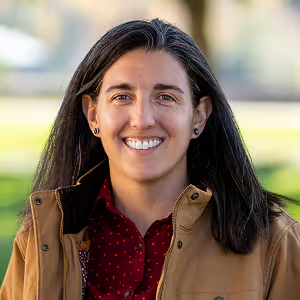
Laura Steele is a content producer at Submittable focused on the world of grantmaking and corporate giving. Her work often explores the connection between technology, equity, and social good.
A corner of the internet for grantmakers
Sub*stance is a publication by the team at Submittable. It’s a destination for the people doing the real work in the grantmaking world. Our aim is to craft pieces that dig beyond the surface level, where the real substance sits.
Explore Sub*stance.avif)
.avif)