Ann Mei Chang on how data will shape the next era of nonprofit work
Candid CEO Ann Mei Chang explores how she sees nonprofits coming together to chart a new course forward for the whole sector.

Ann Mei Chang on how data will shape the next era of nonprofit work
39:28 MINCandid CEO Ann Mei Chang shares how the organization is equipping nonprofits with the data they need to rebuild the sector in a new image.
Description
This episode of the Impact Audio podcast features Ann Mei Change, CEO of Candid. She digs into how data can help create a new status quo for the nonprofit sector.
She explores:
The tools that are changing how nonprofits use data
How timelines and expectations can shift to better support innovation
How nonprofits should calibrate their approach to AI
Guests

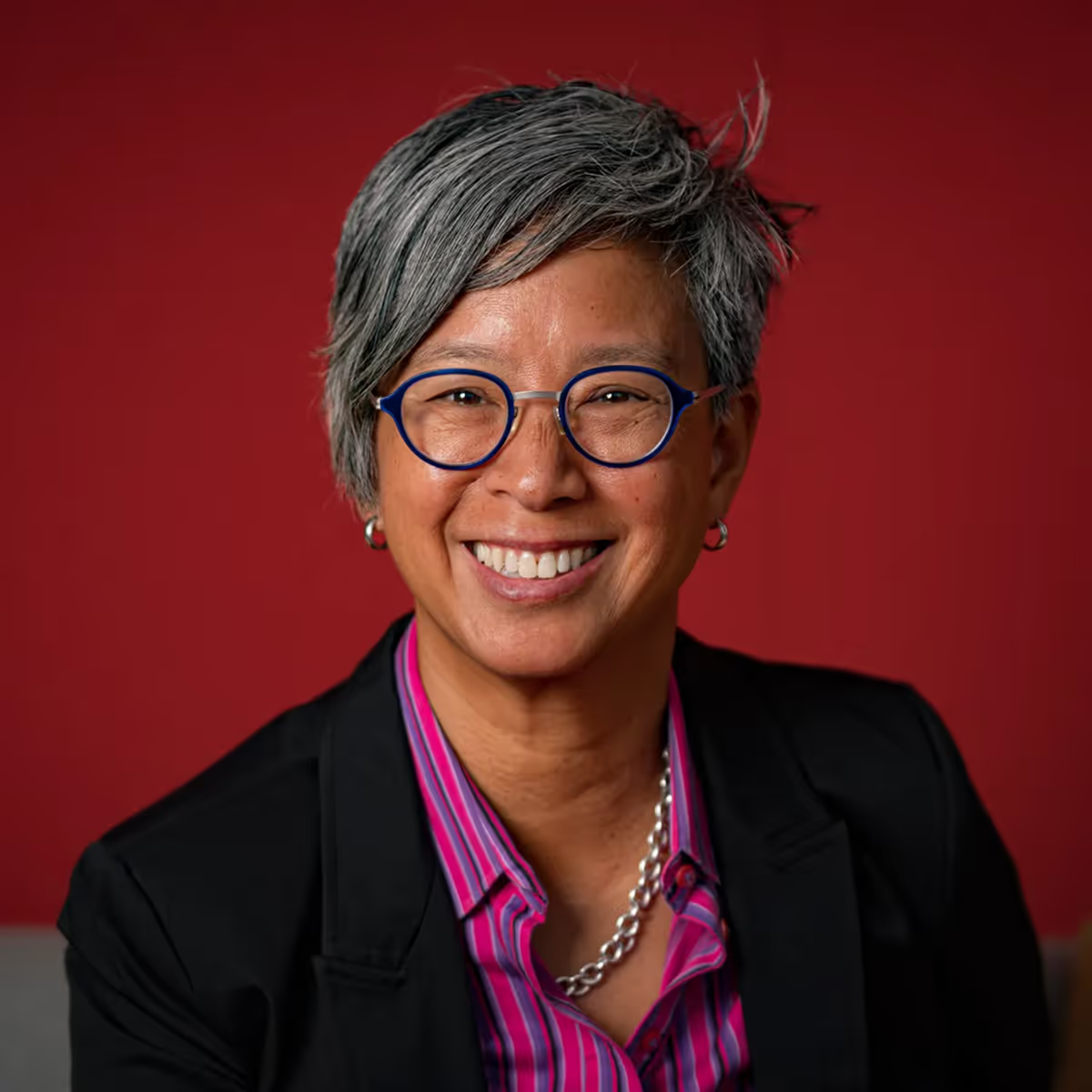
Ann Mei Chang
Ann Mei Chang is the CEO of Candid, a nonprofit that provides the most comprehensive data about the social sector—where money comes from, where it goes, and why it matters. She is also the author of Lean Impact: How to Innovate for Radically Greater Social Good. A leading expert on social innovation, Ann Mei previously served as the Chief Innovation Officer at the U.S. Agency for International Development (USAID), Mercy Corps, and Pete for America. As the first Executive Director of the US Global Development Lab, she harnessed best practices for innovation to accelerate the impact and scale of solutions to the world’s most intractable challenges.
Prior to her work in the public and social sectors, Ann Mei was a seasoned technology executive, with more than 20 years of experience at Google, Apple, and Intuit, as well as at a range of startups. As senior engineering director at Google, she led worldwide engineering for mobile applications and services, with a mission to bring the next billion people online.
She was recognized in The Nonprofit Times 2024 “Power & Influence Top 50, “Women in the World: 125 Women of Impact” by Newsweek/The Daily Beast in 2013, and “The 23 most powerful LGBTQ+ people in tech” by Business Insider in 2019.
Ann Mei earned a B.S. in computer science from Stanford University and is a member of the Aspen Institute’s Henry Crown Fellows class of 2011.
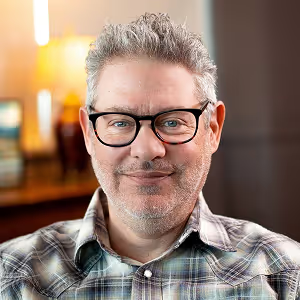
Sam Caplan
Sam Caplan is the Vice President of Social Impact at Submittable, a platform that foundations, governments, nonprofits, and other changemakers use to launch, manage, and measure impactful granting and CSR programs. Inspired by the amazing work performed by practitioners of all stripes, Sam strives to help them achieve their missions through better, more effective software.
Sam formerly served as founder of New Spark Strategy, Chief Information Officer at the Walton Family Foundation, and head of technology at the Walmart Foundation. He consults, advises, and writes on social impact technology, strategy, and innovation.
Connect with or follow Sam on Linkedin, listen to his podcast Impact Audio, and subscribe to his bi-weekly newsletter The Review.
Transcript
Episode notes:
Follow Ann Mei on LinkedIn
Learn more about Candid
Transcript:
This transcript was automatically generated.
Data has always vets the nonprofit sector in some ways.We know that progress often hinges on it, but challenges around standardization and security, access, transparency, they always seem to get in the way.Right now, the nonprofit sector is facing this really important moment. AI is completely changing how we understand and how we utilize data, while nonprofits are navigating a whole new funding and legal landscape. I think it's critical for the whole sector to come together to try to clear and cohesive and more equitable way forward.Luckily, we have organizations like Candid leading the way.Welcome to Impact Audio. I'm Sam Kaplan, Vice President of Social Impact at Submittable.Today, I sit down with Anne Mei Chang, CEO of Candid. She digs into how the organization is creating data infrastructure for nonprofits and helping shed some of the old models that have held the sector back.Ann Mei Chang, this has been such a long time coming. I'm super excited to have you finally as a guest here on Impact Audio. So welcome.
Speaker 2Thank you so much. Thanks for having me, Sam. It's great to have one of our really fun conversations be recorded.
Speaker 1I know, I know. Like people don't know, like we get together pretty regularly and we trade insights and ideas on the nonprofit sector and grant making and data and all the fun topics out there. So yeah, we're going to do our best just to make this one of those conversations.
Speaker 2Sounds good to me.
Speaker 1Yeah. All right. Well, and as soon as I say that, realize I have to ask you about you. So even though I think I already know the answers, tell me a little bit about your background, Ann May. So I know that you have this sort of rich history working in the tech sector and you moved to Candid four years ago, I think now. So catch us up a little bit on you.
Speaker 2Thank you. Well, I've done a little bit of everything.I studied as a software engineer, worked in the tech industry for over twenty years in different roles in management and included places like Apple and Google and Intuit, as well as some startups. But then I made a long plan pivot to do something more meaningful. I started out actually in government. So went from Google to the State Department and worked in government both at the State Department and at USAID, really looking at global development and trying to figure out a path for how could I take the skills I had from the tech sector and bring it to doing good in the world.That led me to write a book called Lean Impact that really tried to capture how do we harness these best practices for innovation that we've learned in Silicon Valley, but apply them to doing more good in the world. And since then, I've worked with a number of different nonprofits and have been at Candid now for just over four years. So I think of myself as a trisector athlete where I've been in the public, private, and social sectors. And I think it's like the few of us who've done that, I feel like it's such a precious opportunity to really understand how these pieces of the puzzle can fit together and really work together to drive the kind of change that we need in the world.
Speaker 1So how do they fit together? Like, are there any similarities between those three sectors?
Speaker 2There are similarities and there's also differences, of course. I think each sector brings its unique strengths and its unique limitations, right? The private sector is probably like the fastest moving, has the best talent and can be really focused on driving results.But it doesn't necessarily always have a soul. Those results are often in the service of making more money for people who already have a lot of money.And so it can go awry. On the other hand, the government is really in service of people, in service of voters and the people in the country. And it has the real benefit of being able to do things at massive scale to drive policy change, systems change, to really solve problems at a scale no one else can solve. On the downside though, government moves pretty slowly.It's hard to drive change in the government. And it can also be a little bit removed from people in local communities. And so that's where I think nonprofits come in, that nonprofits and the social sector in general, I think, is fills in the cracks between where there are, market failures on the on the private sector side and where there's policy failures on the government side, where the social sector really is able to fill in those gaps and has more is closer to communities, understands those issues better, and is able to test out different models across the country to figure out what might work and hopefully scale those things over time, either through market or through government or policy change.So I think the three all play essential roles, I think magic happens at the intersection.
Speaker 1Yeah. I think you're getting it right. Like, we often talk about philanthropy in terms of it being like risk capital and a place for experimentation. Then to your point, we hope that either the corporate sector or the government will take some of the best solutions that are uncovered in nonprofit and scale those.I think there have been some really interesting examples out there like Gates Foundation has had some pretty amazing success in terms of investing in various healthcare innovation and then seeing that get scaled, whether it's been on the corporate side or the government side out there. Like, do you feel like that's the right model? And do you think it actually works? Like, are we seeing government pick up some of these great ideas that come out of the nonprofit sector? Or are we seeing corporate America pick up some of these great ideas?
Speaker 2Yeah, absolutely. I mean, I think we see both of those things happening in in many different forms, sometimes small and sometimes large. Right? So, yeah, I do see both, you know, experiments that are run-in the nonprofit sector find a business model and then get picked up by the corporate sector where they're able to reach deeper into markets and serve communities that they might not have served otherwise, as well as the government sort of being able to modify its policy based on, for example, experiments that nonprofits had did around, like, you know, what are best ways to help the homeless. Right? And the government is able to step in and change policy in terms of how we stepped in.
Speaker 1I don't know if you see this, Anme. I see a lot of it in all of the conferences I go to and on LinkedIn and other places where people from the nonprofit sector are gathering to trade ideas. And it seems like there's always this idea, especially around artificial intelligence like that, that's the tech du jour. So people are talking about it a lot that like the nonprofit sector itself ought to be more responsible for building the technology and the solutions and the innovation that we as a sector are using to do our work rather than relying on the corporate sector to develop these tools or provide these innovations for us. Do you have any thoughts on, is that one, I'm just wondering, do you agree? And two, even if we do agree with that, do you think it's plausible that the nonprofit sector can provide this innovation rather than partnering with corporations and others?
Speaker 2That's a really interesting one.I'm at my heart, like very much like trisector, I think we all need to play a role there. So I don't think that the nonprofit sector should or would benefit from working independently of the for profit sector, but I think that it can leverage the work that is done there and really harness it for good. The the challenge of having the nonprofit sector try to drive these things ourselves is that the the tech sector is literally plowing hundreds of billions, if not trillions of dollars into innovation. And they are paying people millions and millions of dollars, top talent, to drive these things.And they're buying boatloads of data centers and things. The nonprofit sector can't possibly keep up with that. And I don't think it's I think us trying to do it at a smaller scale, we're just never going to be at the cutting edge in that way. So I do think we need to leverage some of the progress that's made there.We also need to be a voice as these new technologies are being developed for making sure that there are safeguards so that the technologies benefit and not harm our communities. So those are roles that I think the nonprofit sector should absolutely play in terms of partnering with the tech sector. And I think that we should harness the advances that are developed for good. And that piece of it, I think, is unique to the nonprofit sector because it's never going to be as high a priority for for profit sector.
Speaker 1Yeah. And so I want to pivot just a little, and I'd love you to tell us all about Candid and your time there and sort of Candid's mission. I'm also really curious, like, based on what you were just saying, like, can Candid potentially be a voice or a partner for the for profit sector in terms of helping shape some of these innovations and technologies, especially around data?
Speaker 2Yeah, and I think we already are. So just to maybe take a step back and share a little bit about Candid for folks who are listening who may not be familiar, Candid is a nonprofit. We were formed a little over six years ago through the merger of two longstanding nonprofits, GuideStar and Foundation Center, who are pillars of the sector, if you will. And together, we have the most comprehensive data about the social sector.So that means data about nonprofits and their work as well as foundations and their giving. So we're able to now paint this three sixty view of what's happening across the social sector. So some of the ways people know us are through our profiles. We have LinkedIn like profiles that over one hundred thousand nonprofits have shared information about their organizations with us, being able to tell their own stories so that they can be found by funders.We have funders who come to Candid to be able to research and vet nonprofits. And our raw data is used by over one hundred other platforms who are some of the biggest donor advised funds, donation platforms, and otherwise leverage our data. So when people share their data with Candid, it goes beyond just our products and to everywhere else. And so our mission at its heart is really about getting people information they need to do good.And we really believe that fundamentally transparency and good data will help both nonprofits and funders drive better decision making and achieve greater impact.
Speaker 1Yeah. And certainly Submittable is a big fan and big user of Candid data as well. So like, you know, one of my favorite initiatives that has come out of Candid during your tenure has been, you know, the data one x or data one time initiative. I think the idea behind that is that nonprofit organizations, especially those who are applying for funding, like we ask them to, in every single grant application to provide the same data over and over and over again.And it causes a tremendous amount of burden and costs a lot of time and money and energy for them to constantly have to reenter that same data. So the idea there was people at nonprofit's can enter, know, create a profile on Candid and then all of us, grant management platforms and impact measurement platforms, we can just tap into that data at Candid and reuse it, right? And be assured that we're always getting like the freshest data from nonprofits. We save them a lot of time and energy and heartache from having constantly tell their story the exact same way over and over and over again.So thank you for putting that together. And I'm curious, is that still one of the key initiatives at Candid as we move into twenty twenty six?
Speaker 2Yeah. So we call our vision Data One X. It stands for Data One Time. And the idea is to create a world where nonprofits can share data about themselves just one time, and it can be used by anybody who needs it.This is like sort of standard course of business in the private sector. When companies put out information companies don't share different information in some bespoke way for every funder that they have. They have a standard set of information. There's prospectus or their SEC filings or whatever.And people get that information and use it to make their decisions about whether to invest. On the other hand, on the nonprofit side, it's it's even worse than you described. It's not just having to fill out the same fields over and over again. It's that the fields are all different in slightly different ways.So you can't even use the same answers again. So compared to the for profit companies, nonprofits spend an inordinate amount of time trying to transact with their funders. Right? Both finding the funders, applying for funding, and reporting to their funders is like orders of magnitude more than what happens in the for profit sector.And I think it really takes away from our ability to drive impact. So our our desire is to make it much easier by standardizing that data. And just to give an example of what that looks like, our first sort of baby step towards this vision is an initiative we call demographics via candid. What we found was that in the wake of the racial reckoning in twenty twenty, many foundations were became very interested in understanding not just what they were funding, but who they were funding.They wanted to get demographics data about the nonprofits they were funding. And it seemed like every foundation went out there and hired their own consultant who came up with their own demographic questions and categories. And then they fielded their surveys out to nonprofits so that nonprofits like Candid, we get about one hundred of these surveys every year, which are all slightly different. So one is like, what is a race of your racial breakdown of your board?One has eight categories. One has ten categories. You can't reuse the data again. So it's sort of ludicrous that then you have to resurvey people so you can slice and dice differently.And it's just a little microcosm of the types of challenges nonprofits face in just simply being able to share information that is very similar with a number of different funders.
Speaker 1Yeah. I think it's a really, really great example of how we can do a much better job of enabling nonprofits to standardize their data, provide it on their terms. Right. And then those of us who are asking for that data can find ways to adapt to it.It's a great way also of like leveling the playing field and resetting that power imbalance. You know, for many, many years, I think funders have had the luxury of being able to hire those consultants and come up with a very unique way of asking the question that serves their exact needs, but at the same time causes all of that rework and burden on nonprofit organizations. So there's been some other really fun activities happening at Candid as well, right? So you guys have been merging systems and databases.Me a little about what's going on there.
Speaker 2Well, it's very exciting that we're on the final sprint for integrating all of our legacy systems onto platform that we call CandidSearch. And so this is taking our flagship products, GuideStar and Foundation Directory, and integrating them into a built from scratch next generation platform that both takes the best of what those products offers and adds in, you know, refreshed user interface that's much easier to navigate as well as new features, some leveraging AI that will make it much easier to get answers to users. So we're super excited. It's already launched on canada dot org. If people want to check it out, just go to the search bot on canada dot org, and we're still finalizing some elements of it before we take it out of beta and have a full launch.
Speaker 1Yeah. And big testimonial for me. I've been a user of this since the early days of when it began to get merged in a beta environment.It is just so useful, so helpful. I do tons of research using various Candid products to understand sort of Submittable's customer base and really the nonprofit sector to try to find insights into some of these issues of the day. And I think that the way that you're combining data and the user interface that Candid has developed just makes so easy to find the data that is really useful and that I'm actually looking for. And I've tried many other tools out there. And at this point, like I am a fanboy, I'm totally sold on what you guys are doing.
Speaker 2Love it. Thank you so much for the testimonial, Sam. We're gonna put you on the road.
Speaker 1Nice. I'm already on the road. So I'll carve out a few minutes to talk about Candid everywhere I go.Yeah, like what's going on in terms of the coming year? So we're almost to December twenty twenty five when we're recording and, you know, what are you guys thinking about in terms of how things will evolve at your organization in terms of strategy or new initiatives?
Speaker 2Yeah, so next year is going be an exciting year. We're going to, beginning of the year, do the full launch of the new Candid platform. So that will be probably the biggest thing, although it'll be at the very beginning of the year. And we're excited that as we launch the new platform, that's gonna unleash innovation across the organization because we've really been focused the last few years on replatforming, going from our legacy systems to building up that functionality on this new platform.But now that we've done that, we really get to, you know, set folks free to figure out what are the new problems we can solve with the latest technologies. And so I think teams are all super excited about that. On the nonprofit side, we're, of course, really focused on how do we save nonprofits time and relieve this burden on profits. And so we're looking at ways that we can leapfrog ourselves in terms of leveraging the latest advancements to be able to save nonprofits dramatically more time in identifying and securing funding for their missions.On the funder side, we're really excited about one of the things that we've heard a lot from funders is that in this current world where funding is shifting much more rapidly than it used to because of federal funding cuts and federal funding shifts and then therefore foundation shifting what they're doing, people need to have visibility of what's happening so that they can make good decisions. They need to know what is getting funded, where the gaps, new gaps are now. And so we're gonna be looking at how can we both provide better visualization tools for people to understand how funding is flowing within their areas or spheres of interest, if you will, whether that's geography or issue area or both.And have a strong campaign to really drive much fresher data. We already have much fresher data than nine nineties through the hundreds of foundations that we call e report to us and share their grant data directly with us in advance of their 990s being published. And we really want to build on that so that we have a much more current view for folks on what's happening. So those are a couple of the product initiatives.We're also going to continue to play a really critical role with all of the crosswinds the sector is facing. There's been a lot of attacks on both foundations and nonprofits, as well as from a policy perspective, as well as from a funding perspective. And we've really been playing a role of providing the data both to advocates, to the press, and publicly through dashboards and blog posts to help people understand and be rooted in the facts of what might happen if federal funding to nonprofits was cut. That would affect probably about thirty percent of nonprofits out there and have a pretty significant impact.And when people say, oh, foundations can step in, for example, what we found is that it would take every single foundation increasing their payout by almost three hundred percent in order to make up for the government funding. Government is just huge. And so we're just trying to publish data like that so that people understand and can have some perspective on how the things that are happening or might happen, what the impact of those things might be.
Speaker 1Yeah. So let's talk about that a little bit. So there are things happening. It has been a really, really tough year in the nonprofit sector, an unprecedented year in so many ways. And whether it is nonprofits seeing their funding cut, whether it has been sort of the politicization of many of the organizations, both on the funder side and the nonprofit side, In a lot of ways, I think it has caused, you know, in some ways, like we're at a standstill and people are reeling and trying to figure out like how to react to everything that's happening in other ways, like we're moving faster than we ever have. We're seeing organizations out there like MacArthur that are stepping up and really sort of like taking on the fight, committing more funding to help nonprofit organizations. Like what is your take on what has the last ten months or so been like?
Speaker 2It's been a whirlwind, honestly. I I think it has been for all of us. I think we never know where the next shoe is going to drop. And so I think it's been pretty crazy for us and for everyone.And I think that uncertainty is hard because we just don't know what's going to happen. Lots of things have happened that we didn't expect.And I think lots more will happen that we haven't expected. So it's been a rough time. I think one of the and everyone's been scrambling to try to figure out how to fill the gaps that keep being created. And so one of the good things that's come of that that I've been really excited about is just how well the sector has really come together. I think better than universities, law firms, and others who have come under attack, the social sector has really had each other's backs.We're seeing organizations that used to squabble with each other constantly, like really join arms and march forward together and really leverage each other's expertise. It's been really heartening to see. So it's great to see some of that kind of come together.I think the thing that you and I have talked about before that I'm concerned most about is that there's so much blocking and tackling that understandably we have to do because people's lives are being put at risk futures are being put at risk. But there's so much blocking and tackling that I worry we're missing the bigger picture of how we're going to change the arc of things. Because the reality is that we're not going back to the world that we came from. You know, whether we want it or not.But that I feel like there's a lot of effort to protect the status quo. Because it's something we're familiar with. And I just think that that's going to be a losing battle. And we also need to put some effort into figuring out what's the new status quo we want to create.Because most of us weren't happy with the status quo before this.And so I think as much as we might hate some of the changes that are happening, it's also an opportunity to create something better. And I'd love to see us all collectively put a little bit more energy into envisioning what is the world that we want to create out of this.
Speaker 1Yeah. Do you feel like the leaders across the sector are thinking about how we collectively reinvent rather than try to rebuild or maintain that status quo? Like, do you feel like they're receptive to that idea that, like whether you want to or not, this is a time of reinvention all of us in the nonprofit sector.Whether you want to or not, like we're not going to go back to the way that things were two or three years ago. And in a big way, to your point, we shouldn't want to go back to the way that things were two or three years ago. Like there was, that's why we have been talking about things like the inequity and the power imbalances and the burden imposed on nonprofit organizations and the lack of our ability to do a good job in figuring out if we're making an impact on systems. So what do you think? Are we going to in some way take advantage of this as an opportunity to reinvent?
Speaker 2I hope so. I'm only just recently starting to see signs that people are thinking about this. Again, I think everyone's been blocking and tackling again for good reason. So, I'm not I totally have empathy and and understanding for why we're doing the blocking and tackling but I feel like we're just starting to see signs of people lifting their heads up and looking towards the horizon of what we might do. And I hope that we can build on that and carve out enough space to really envision where we want to go because I think that's the only way we'll be able to get there.
Speaker 1And where do we want to go? Where does Anne May want to go?If you could wave your wand and have us reinvent the sector in a way that works better than it has in the past, what might that look like?
Speaker 2That's a good question. I spent most of my career in Silicon Valley and there's a lot of both good things and bad things about Silicon Valley. One of the good things about Silicon Valley was just pace of progress. That things happen fast and improvements happen fast.And we need that pace of progress in the nonprofit sector. And I think there are systemic barriers to us being able to do that most prominently the sort of funder nonprofit relationship. There's a real power imbalance where funders hold all the strings. Right?They they hold the money. They get to dictate the terms. And I think that there's an opportunity as we rebuild the sector to think about how we can rebalance that a bit.If I can just share briefly how Silicon Valley works. If you're a startup company and you have a great idea, you pitch you have a pitch deck. You go out and you sell a bunch of funders on the pitch deck. They decide to write a check.And then they basically give you some runway and leave you alone. And then at the end of the time, if you've been able to demonstrate you made good progress, then they cut you another check. And if you don't, then they go away. That's a simple explanation of how funding or venture capital works.The good thing about this is that these startups don't have to spend a ton of time raising money or dealing with their funders. They can just go off and they have a lot of freedom to try to innovate. And they have the incentive to innovate because if they come up with something, that's where they get the big reward. So when we turn to the nonprofit sector, most typically when nonprofits get funding, they get it in the form of restrictive funding that, in many cases, can be down to the penny where money needs to be spent.And what that means is both in a dynamic world and in a world where our solutions aren't good enough when we need to innovate, our arms are tied behind our back. We're spending all our time trying to plan ahead of time for what we're going to do for the next three to five years, which is just not foreseeable, because who would have known what we needed to do this year three or five years ago, right? And then trying to stay slavishly adhered to that plan in order to please the funders. And I think that just holds that sort of fundamental relationship holds back so much opportunity for the nonprofit sector.And that's the thing I hope most to change. We're already seeing movements towards that with things like trust based philanthropy that is really promoting the idea of general operating support or unrestricted funding, which is essentially how startups work and reducing the burden of applications and reporting and all of that kind of stuff so that nonprofits can do the work that they are set up to do.
Speaker 1I'd love that vision and I hope it comes to fruition at some point. We saw during COVID days that many funders switched their operating model to provide more unrestricted funding to nonprofit organizations. And I think they were compelled to because they realized if they didn't, there were many nonprofits that were simply not going to survive. So the hand was forced and they did And then unfortunately, like now there's a lot of evidence that shows that many of those same funders have like gone back to the way that they always did it. You know, at best maybe, you know, fourteen percent of a grant or whatever is unrestricted to pay for so called overhead. Then the rest is really all about buying impact.To your point, I agree completely. I hope that we do reach a point in time where more funders are willing to make those venture like investments into nonprofits and their initiatives, and then take a big step back and let the nonprofits do what they do best. No doubt some of those will be successful, some of them will not, it's a proven model that has worked in Silicon Valley. I'd like to see more opportunity for nonprofits in our sector have that as well.
Speaker 2I absolutely agree we need to give nonprofits more flexibility. And one of the reasons for that, now there's two reasons for it, internal and external. Internal is it allows nonprofits to take risks, to innovate, to experiment where you don't know exactly what's going to happen next. And you just can't do that with highly restricted funding.The external piece is the world is changing faster and faster. Know, we had COVID. We had all the policy changes we're seeing this year. We have the extraordinarily fast pace of technology revolution with investments happening in AI right now.And so the notion that you can plan ahead and have, like, a detailed, you know, plan that you can sign on on with your funder and say, this is what I'm gonna do. It's just a fallacy more and more that that is meaningful.So I think that the external forces will hopefully wake funders up to say, hey, we can't predict what the world's going to look like in two years.
Speaker 1I completely agree with you. I think that this is such a great opportunity to really rethink like, you know, the whole idea around what we expect out of nonprofit organizations when we fund them. What do you think has to change on the nonprofit side there as well? Do they need to do a better or a different type of job in terms of showing their progress and what they're actually achieving over time once they receive that unrestricted funding? Or is it really just like, we'll come back in three years and tell you what happened?
Speaker 2Well, I don't think it should be three years. I'm a big fan that when it comes to innovation, it's really important to think big and start small. And I think a nonprofit struggle with both of those things, largely because they've worked in a context where they weren't allowed to do either. And so that gets seeped into the culture where those muscles just atrophy.So the think big part is like, I just don't think we're ambitious enough. You know, nonprofits generally put forward things that are fairly well understood that they generally understand how they're going to be able to achieve so that they can deliver what they're promising funders, right? It's a natural part of the bargain. So, of course, they don't like, you know, swing big for things that they're not sure they can do.So, learning how to think bigger and really come up with solutions that meet the size of the need and the and make the degree of impact that will fully achieve our missions is something I think we need to get better at. The other side of that, and this is to your three year point, is the starting small. We also, because of the way funders have trained nonprofits, are accustomed to having a three year plan and executing on one thing for three years come high or hell or high water. But the reality is if we're trying to innovate, we should take much smaller steps because what's important when you're innovating is how fast you can learn.So if you can run a one day experiment and learn something or a one week experiment and learn something, and then that informs your next step, which may be in a different direction than you would have thought before, you can make much faster progress than if you have a three year plan and then come up for your error in three years and see whether your thing worked. So I think that's a muscle that we're going to have to develop and a culture shift we're going to need to make in order to drive more innovation in the nonprofit sector.
Speaker 1Yeah, agile philanthropy. Yes.Nice. Before I let you go, Anne, may I have to ask your perspective on AI, of course. I just got back from the TED conference and many of the sessions, as you would expect, were focused on the use of artificial intelligence and grant making and philanthropy and impact measurement.How are you thinking about AI? How is Candid thinking about AI? I'd love to hear your perspective.
Speaker 2Yeah, can't have a conversation without talking about AI anymore, right? That's right. Yeah, I like everyone recognize the incredible power of AI and how it will likely transform our societies in ways that we can't anticipate, both for better and for worse. And I think we should all be in awe of that power.I do think that with any technology advancement, there's always a scramble to try to use that technology for something. Right? It's a sexy new thing. And so I think there's a bit of this, like, hammer looking for a nail. Like, use AI for this, that, or the other thing. And I think that's a little dangerous because it's just if you're just trying to find an application of AI, you're probably not solving a real problem. I'm a big fan of starting with the problem you're trying to solve and having the full suite of tools on your desk so that you can pull from the ones that will be most helpful to you.Candid, AI is not a new thing. And I joke about how these days people are talking about this new thing called AI. I took my first AI course in college over thirty years ago.So to me, it's like we've been a long standing thing. We've seen AI be used in anything from Amazon recommending products to you to Netflix recommending movies to you. These have been around for a long time. The new progress in AI has largely been around generative AI.And that has really taken the world by storm and exposed AI in a way that people can see, touch, and feel a little bit more directly than AI in the past. And I think it's really captured people's imaginations.But at Candid, we've had a machine learning team for over a decade.We've been using AI techniques in order to both be able to capture data, to be able to categorize that data, make sense of that data, clean the data, de dupe the data, and so forth. So we've been doing a lot of things with machine learning for a long time now.And we're starting to harness these new advancements in AI. We have a labs page, candid dot org slash labs, that has some of our early experiments with AI in our domain, where we have a chat bot to answer your questions about philanthropy and the social sector. We have recommendations of funders. We have letter of intent generator. So we have a bunch of these tools that we're sharing with the sector and experimenting with to figure out what's really going to be helpful to make a big difference in people's work.
Speaker 1Yeah, do you think that the data that Candid has could ever play a role in developing a philanthropy based large language model or perhaps at least doing a better job of training what's already out there?
Speaker 2Absolutely. That's something we think about a lot. We are looking at some of those things ourselves on our end. And we're also looking at how we can provide data to others who are trying to do that.The the real there's, you know, again, with any powerful technology, there's always upside and downside. So it holds the promise of making it much easier to access and and get answers about this information. It also, has the risk of that information being misconstrued or misused. And so we're really trying to be thoughtful about how we can get the data out there in a way that AI models will actually understand the nuances fully and be able to get the meaningful answers to people as a result.
Speaker 1I've worked at a couple of big foundations. And as much as I wanted to promote data sharing from our own organization, it felt like the conversation always got hung up with our legal counsel. Is that a thing or is that just my experience? Have you guys figured out the secret sauce to getting legal teams at foundations and nonprofit organizations to loosen the grip in terms of data sharing?
Speaker 2We already have numerous nonprofits and foundations that share data with us.We may not be looking at quite as sensitive data because the data that we tend to capture is data that we make public. And so we're not talking about super sensitive data with PII or so forth that the lawyers might get more wrapped up in.But we have our share of lawyers that we work
Speaker 1with you.And May, I knew that this conversation was going to absolutely fly by. And I've had such a great time hearing your incredible perspectives on so many different topics. So I guess thank you so much for joining me.You know, we'll get we'll continue our regular get togethers and these conversations that we have and can't wait to see you in person at a conference at some point in the spring.
Speaker 2Sounds good. It's always a pleasure, Sam. Thanks so much for having me on your show and let's get together again soon.
Speaker 1Over the last few years, nonprofits have had to get accustomed to an incredibly swift pace of change. That doesn't seem to be letting up. The big question is, how do nonprofits dig in and do the day to day work, that blocking and tackling, without losing sight of the bigger picture?A big part of the answer is in coming together and leaning on organizations like Candid. I'm glad they continue to be so committed to this work because we all benefit from it.That's all for me today. Thanks for tuning in to Impact Audio, produced by your friends at Submittable. Until next time.