
David Hessekiel
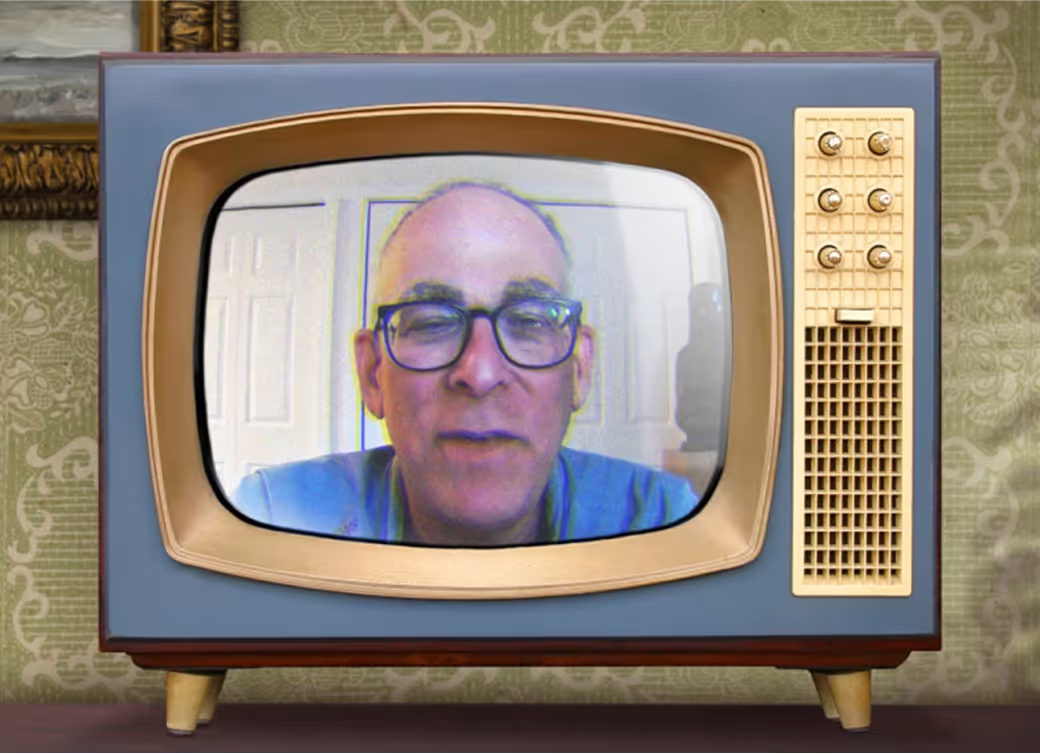
In his 20+ years of leading Engage for Good, David Hessekiel has seen expectations around social impact soar. In today’s CSR landscape, neutrality is no longer an option. Companies have to take a stand and find authentic ways to put their values into action. In this episode, he covers:
- How the origins of cause marketing have shaped today’s CSR
- Why companies are stepping into more complex conversations
- The factors creating a sense of urgency around CSR
David Hessekiel leads Cause Marketing Forum, Inc. (CMFI), a firm dedicated to educating, inspiring and bringing together professionals committed to integrating purpose and profit. The CMFI team tackles this through its two brands: Engage for Good and the Peer-to-Peer Professional Forum.
A regular blogger on Forbes.com, David firmly believes that companies can simultaneously build a better world and the bottom line. The recipient of a BA from Wesleyan University and an MBA from the Stanford Graduate School of Business, Hessekiel is a former journalist, publishing and consumer marketing executive and consultant.
- Learn more about Engage for Good
- Read Milton Friedman’s 1970 article on the role of business
- Revisit the American Express campaign to renovate the Statue of Liberty
- Check out the social impact work of Patagonia and Ben & Jerry’
- Learn more about the history of the Breast Cancer awareness movement
- Read about Engage for Good’s Halo Awards
- Get the details on the Engage for Good conference
- Read about how mental health has become a new focus in the corporate sphere
- Learn more about the history of the Mercantile building in downtown Missoula
[MUSIC PLAYING]
If you walked by this building in 2011, you would have found a long stretch of boarded up windows.
Originally built in 1866, the Mercantile Building sits in the heart of Missoula, Montana. In 2010, Macy's, the last tenant, pulled up stakes and left the place empty. And it stayed that way for 7 years, a reminder of what happens when a place doesn't evolve.
Then in 2017, plans to revamp the location finally moved forward. Demolition began. It was a controversial project. Some people objected to the cost, the disruption, and the restructuring of a historical landmark, but in the end, the builders honored the history of the place.
They preserved as much as they could, and they rebuilt with an understanding of what mattered most to the people in the area, room for local shops and restaurants. A new place that wouldn't undercut the historical identity of the town. Today the Mercantile Building is a busy hub for Downtown Missoula.
It's an example of how to build authentically for the future. You have to carry the past forward in a way that makes room for progress, and you have to take some risks. It's a good lesson for anyone working in corporate social responsibility. We can't move the field forward unless we do the work to understand where we've been.
[THEME MUSIC]
Welcome to <i>Impact</i> <i>Studio.</i> I'm Sam Caplan, vice president of Social Impact at Submittable. Throughout my time in the social impact sector, David Hessekiel has been a steady presence. As president for Engage for Good, he has spent the past two decades helping CSR professionals come together to chart the course forward.
He brings an important perspective on how to balance idealism with reality, and he provides historical context on how we got here.
[MUSIC PLAYING]
I think it's really important to take a look back at where we came from. So to that end, I would love to hear from you like what was CSR like 20 years ago when you first started the Cause Marketing Forum and made your entry into the world of CSR?
- 22 years ago, when I think back to what was a part of almost all of these conversations, it's things that are hardly mentioned anymore. So, for example, I had gone to business school in the '80s, and it was the heyday of shareholder value. Nobody was talking about CSR. People who thought anything about values based marketing or management were sidelined into specialized programs, and it was a quaint thing to have at a business school.
It was still a time when people might quote Milton Friedman and say the business of business is business, and that you are taking a major detour and hurting yourself by talking about issues related to your social purpose, your environmental policies. When I started off around 22 years ago, there had been some big moves forward. There had been some major programs in which companies were trying to do well by doing good.
And every presentation that we had put out there would refer back to the American Express campaign from which many people say the name cause-related marketing came from and that was when American Express tied usage of the card to their support for the renovation of the Statue of Liberty and Ellis Island and it did amazing, amazing work generating consumer interest and generating a lot of money, and it caught a lot of attention.
Now, there are people who have been in this field for some time, 5 or 10 years, who probably have never even heard of that campaign and would perhaps even say, oh, well, that was cause marketing and it wasn't a real thing, wasn't genuine enough, it wasn't authentic enough.
But early programs like that in started to prove out the idea that companies could produce major programming that had a double bottom line orientation doing something that was legitimately good for the company as well as good for the greater world.
It was also a time--
and again I was in this world of cause marketing where that kind of cross-sector partnership was so important--
it was a time where there was tremendous distrust within organizations and across sectors. People who worked within corporations and worked on this type of program where they try to align profit and purpose, it was a very patronizing time where people say, oh, that's really nice you do that sort of thing, but that's not real business.
And people who worked at nonprofit organizations were trying to develop meaningful corporate alliances were often looked at as sellouts by the people who worked at nonprofit organizations who literally thought that marketing was a four letter word.
That they were in nonprofits. They had gone there. They had made sacrifices to work at those places financially, and that they didn't do marketing, and they certainly didn't work with the corporate sector. So that's what it was like when we first started out with cause marketing forum, and over the years, it's been fascinating to watch the field evolve.
- Yeah. That's really interesting listening to you describe like there was a little bit of heartburn on the business side, there was a little bit of heartburn on the nonprofit side. It sounds like there was some skepticism in terms of getting this ball rolling.
And I'm just really curious, how did the sector get past that and move on to the point where cause marketing really gained in popularity? And I think that was the entry point for so many businesses to begin to really think about their social purpose and that there is the possibility of shared value where they can do good for their business and also do good for society.
- Unfortunately, I'm one of those people who sees a lot of shades of gray as opposed to a simple Black and white answer, but a number of factors that I can think of. A, there's nothing like people--
somebody else taking the risk and proving out that by doing some good work that something can actually work for them.
And so there were more pioneers, everything from those who were in the extreme like a Patagonia or a Ben and Jerry's to those who were much more Fortune 500, Fortune 100 companies but who jumped into doing more of this such as--
it was also the heyday for better or for worse of the breast cancer movement.
There was a time--
so we produce--
our mainstay we were called originally the Cause Marketing Forum. We evolved to about seven years ago changing to Engage for Good. In those days it was very much consumer focused, and there were so many mainstream companies who had discovered that they wanted to market to women.
And they had discovered that there was this group led by Susan G. Komen, but there were others as well, that would help them create large campaigns that encouraged people to support the fight against breast cancer. And so it was an embarrassment of riches in a sense because in some of the early conferences that we produced, one of the highlights of each conference is something we call the Halo Awards in which we give out awards for outstanding campaigns.
We were overwhelmed with too many perhaps breast cancer campaigns, but it also provided a great cavalcade of winning programs. I can remember BMW and Yoplait Yogurt and so many other mainstream from grocery shelves to high-end luxury companies that got into it. So that was one factor.
I think the other factor is that we entered an age of everybody having--
almost everybody having access to high speed internet, and suddenly, information was available to everyone on almost everything and it only expanded and expanded all the time. And people started to look into what companies were doing in a way that was much more intense and every day than it had been.
And whether you are cynical and look at it as a defensive move, or proactive and look it as a positive contributory move, companies also needed to do a better job of sharing and making it clear that they were on the right side of a lot of issues and that they were not just a drain on society that was trying to reap profits but were also contributing to society. So those are two factors that I think moved the field forward.
If you went to an event of ours 20-some years ago, these are all good causes and should still be supported, but it was all antihunger, proeducation, antidesease, the sorts of topics that nobody practically would get in any trouble for having supported because they were not divisive.
A perfect example is mental health.
Mental health [CHUCKLES]
as long as people have been thinking and as long as people have been working and living together, people have had mental health issues.
But it was such a "we can't talk about it" kind of a topic that it was not something--
it bummed people out. And so it's not something that companies would embrace.
The tragic events of the last few years, the pandemic being a huge factor and frankly say the political situation in which people are feeling awful and contentious and can't even speak to some of the members of their own family because it's so divided, has raised--
and something along those lines was a straw that broke the camel's back, and now it is a frequently discussed piece of the conversation.
- Hi. I'm Keriann, chief marketing officer at Submittable. David's point about mental health feels really important. Companies cannot opt out of these tough conversations anymore, and the best way to step into it is to let employees lead the way. We're so excited to bring you to this episode as part of <i>Impact</i> <i>Studio.</i> Our goal is to keep creating spaces like this for more conversation.
If you're interested in aligning your CSR programs with your employees values, we'd love to talk to you more about how our software could support your work. Please reach out to our team at Submittable.com. Now back to the episode.
- One of the things I love most about the Engage for Good annual conference is that it really is an opportunity to convene many amazing nonprofit organizations and corporations and practitioners and professionals who are all in this work together.
- Well, one of the things that I'm very proud about is that Engage for Good is an open community that provides a lot of free information for people, and then there are various tiers of getting involved as a full paid member and as a participant in our conference. There's just--
go to www.engageforgood.com, and you will find a huge assortment of information.
I continue to believe that we will have more progress in terms of CSR thinking being pretty baked into management. Now with good economies and bad economies the amount of money is spent may change. The emphasis on how much is put out there in terms of consumer-oriented material versus employee-oriented material would be different, but I don't think that we're going to go backwards where this does not count.
SAM CAPLAN: As we think about how to move CSR forward over the next year and the next decade, let's be sure to do so in a way that honors the past without limiting the future. If the City and the people of Missoula hadn't given a green light to this project, there would likely still be a crumbling boarded up building here.
That's the true risk of idealism. If you get too attached to the value something had in the past, you can hold back progress. And if you lose sense of the history, you can undermine your authenticity. The truth is CSR hinges on striking a balance. I think we're all up to the task. Thanks for tuning in.
[THEME MUSIC]
[MUSIC]
Submittable is a social impact platform that powers your
community investment, employee engagement, and grantmaking
programs. If you want to learn more about how we can help you
and your team do more good, reach out today.